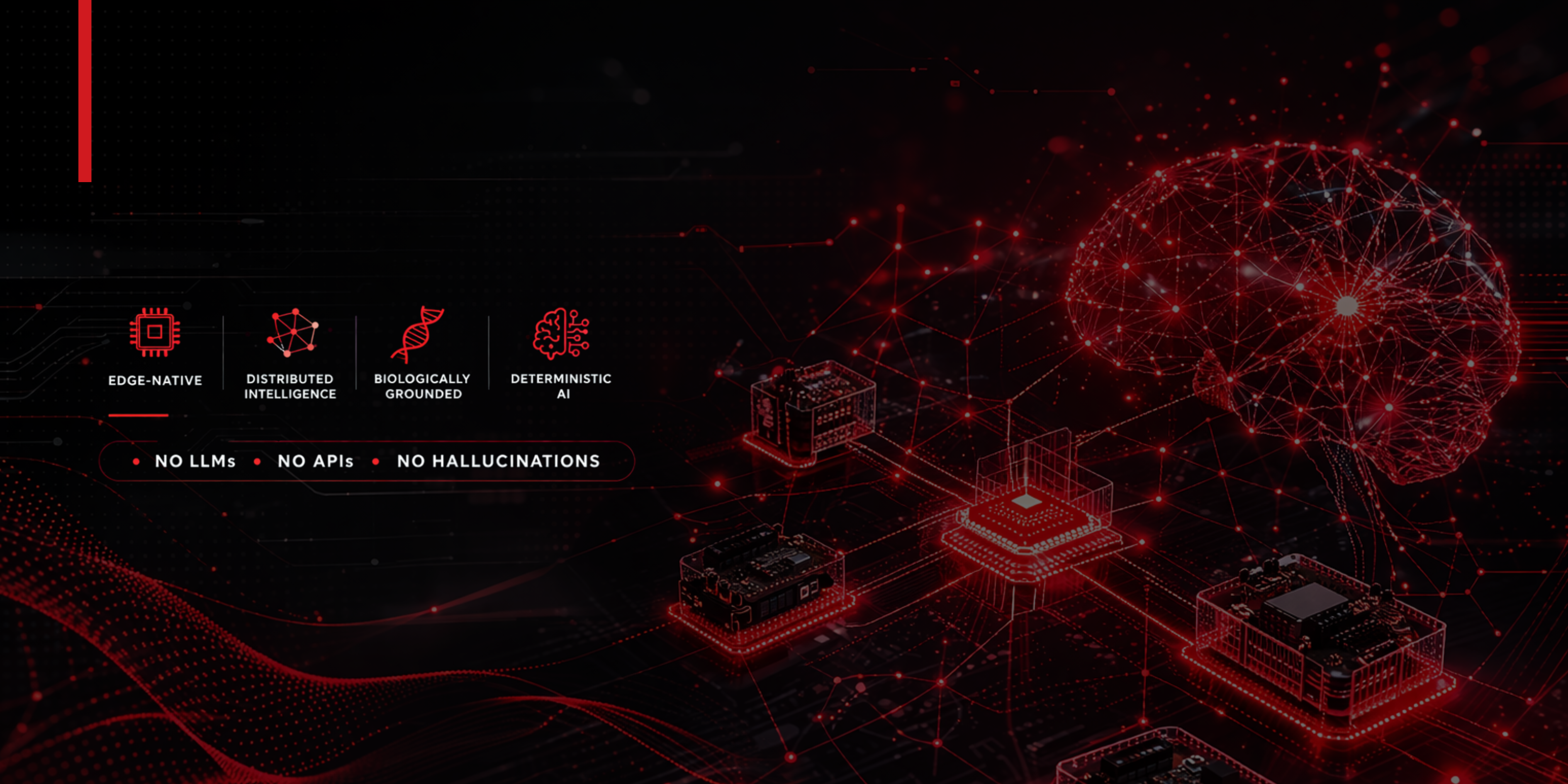


Biology has entered a computational era. From CRISPR gene editing to protein–protein interaction networks, modern life sciences increasingly rely on artificial intelligence to interpret complex biological systems. While biological data generation has advanced rapidly, the way this intelligence is deployed has not kept pace. Most AI-driven biological workflows still depend on centralized cloud infrastructure, introducing latency, privacy concerns, cost barriers, and scalability limitations.
As medicine and life sciences move toward precision, personalization, and decentralization, deployment architecture becomes as important as model accuracy. This shift has led to growing interest in edge-based artificial intelligence, where computation is performed closer to where biological data is generated.
Why Deployment Architecture Matters in Biological AI
Much of the focus in computational biology is placed on model performance, dataset size, and algorithmic novelty. In practice, however, deployment constraints often determine whether an AI system can be adopted in real-world biological or clinical environments.
Centralized biological AI systems face several challenges, including high latency for time-sensitive workflows, dependence on stable network connectivity, regulatory and privacy risks associated with biological data transfer, and limited accessibility for smaller laboratories or distributed healthcare settings. These limitations highlight the need for alternative deployment strategies.
Research Insight: Graph Neural Networks for Protein Interaction Analysis
This work builds on the research paper “Edge-Based Execution of Graph Neural Networks for Protein Interaction Network Analysis in Clinical Oncology”. Protein–protein interaction networks are fundamental to understanding disease mechanisms, particularly in oncology, and are inherently graph-structured.
Graph neural networks are well suited to this problem because they model relationships between biological entities rather than treating each protein independently. Traditionally, such models are executed on cloud-based GPU infrastructure. Experimental evaluation shows that graph neural network inference can be executed reliably on GPU-enabled edge devices, achieving stable performance with low-latency inference and without reliance on centralized cloud GPUs.
Key Observations from Edge-Based Execution
The results demonstrate stable model behavior on edge hardware, inference latency in the millisecond range, and practical feasibility of decentralized biological AI execution. These findings indicate that advanced biological graph models are not limited to large-scale cloud environments.
Why Graph Neural Networks Align with Biological Systems
Biological systems are fundamentally relational rather than isolated. Proteins interact in networks, pathways emerge from connectivity, and disease phenotypes are driven by system-level interactions. Graph neural networks align naturally with this structure by representing proteins as nodes and interactions as edges, enabling system-aware biological modeling.
This makes graph-based learning particularly effective for systems biology, cancer network analysis, drug target discovery, and molecular pathway modeling.
Edge AI as a Paradigm Shift for Computational Biology
Deploying artificial intelligence at the edge changes how biological intelligence is delivered. On-device inference significantly reduces latency, enabling real-time biological insights at the point of care or experimentation. Local processing preserves data privacy by minimizing raw biological data transfer, which is increasingly important in regulated medical and genomic environments.
Edge-based systems also scale horizontally without centralized GPU bottlenecks, making advanced biological intelligence more accessible and cost-effective for smaller laboratories, clinics, and research facilities.
Typical Edge-Based Biological AI Workflow
A common edge-based biological AI workflow begins with biological data acquisition, followed by graph construction and feature encoding. Inference is performed directly on an edge GPU, enabling local decision support and visualization. Optional secure synchronization with cloud systems can be used for long-term analytics, auditability, or model improvement.
Applied Perspective: AI in Biology at PeachBot
Beyond academic research, these principles are reflected in applied systems such as AI in Biology at PeachBot. The focus is on treating biological data as interconnected systems and designing hardware-aware AI pipelines that operate efficiently on real-world devices.
By bridging machine learning, bioinformatics, and edge computing, this approach helps translate research innovation into practical biological and medical systems that can operate outside centralized cloud environments.
Implications for Developers, Researchers, and Investors
For developers, edge-based biological AI demonstrates that graph machine learning extends far beyond traditional domains such as social networks. For researchers, deployment-aware AI design increases translational impact and real-world applicability. For investors, the convergence of biology, artificial intelligence, and edge computing represents foundational infrastructure with long-term growth potential.
Looking Ahead
The future of biological AI will not be defined solely by larger models or larger datasets. It will be shaped by where intelligence runs, how quickly insights are delivered, and how accessible advanced computation becomes.
Edge AI enables biology to move from centralized analysis toward distributed, real-time intelligence. This convergence of biology, artificial intelligence, and edge computing marks a foundational shift in how life science innovation is built, deployed, and scaled.
References: Edge-Based Execution of Graph Neural Networks for Protein Interaction Network Analysis in Clinical Oncology | AI in Biology at PeachBot